The labor movements in Academia (21st Century)
The 2016 National Labor Relations Board Decision
Whether graduate students are considered workers has continued to be a topic for debate in the 21st century. The decisions, usually made by the National Labor Relations Board (NLRB), have been reversed several times in history, depending on the political party that controlled the White House. In 2000, in the case of New York University, the NLRB ruled for the first time that graduate students could unionize; however, in 2004, in the case of Brown University, the Board reversed course entirely, ruling that graduate students were "primarily students" and stripping them of union rights.
It was not until the 2016 NLRB decision in Columbia University that the graduates won back the right as workers. On August 23, 2016, the Board ruled 3-1 that student teaching assistants (TAs) and research assistants (RAs) at private universities are considered employees under the National Labor Relations Act (NLRA) and therefore have the federal right to unionize. There are two core reasons that supported the decision. Firstly, "student" and "employee" are not two mutually exclusive identities. The 2004 Brown University decision argued that because these individuals were "primarily students," they could not be employees. The 2016 Board rejected this binary thinking. Just because we are students doesn't stop us from being workers. The second reason is that the productive relationship between the university and the graduates as a TA or RA is a standard employer-employee relationship. Universities direct our work, control our hours, and pay us for our services. The decision removed the legal shield that private universities had used to block union drives for twelve years. While universities can still delay negotiations, they can no longer claim that the union is illegitimate under federal law.
It is also worth mentioning that with the support of the Local 6516, in 2025, the Rhode Island government passed a state bill that ensures student workers are considered employees. No matter what decision the NLRB makes in the future, the right to unionize and collectively bargain will still be in the hands of graduate and undergraduate students in our state.
2021 Columbia University Strike
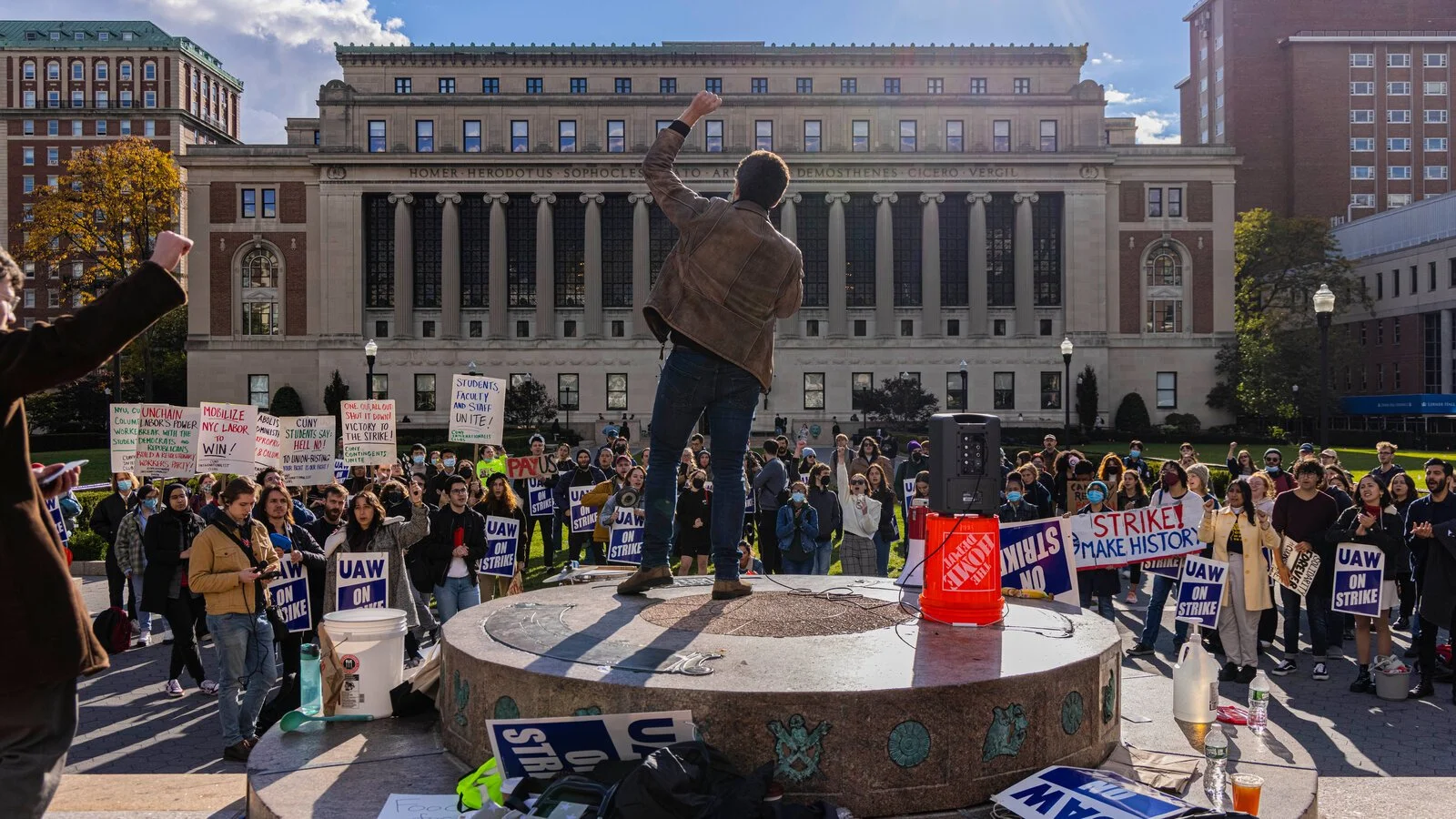
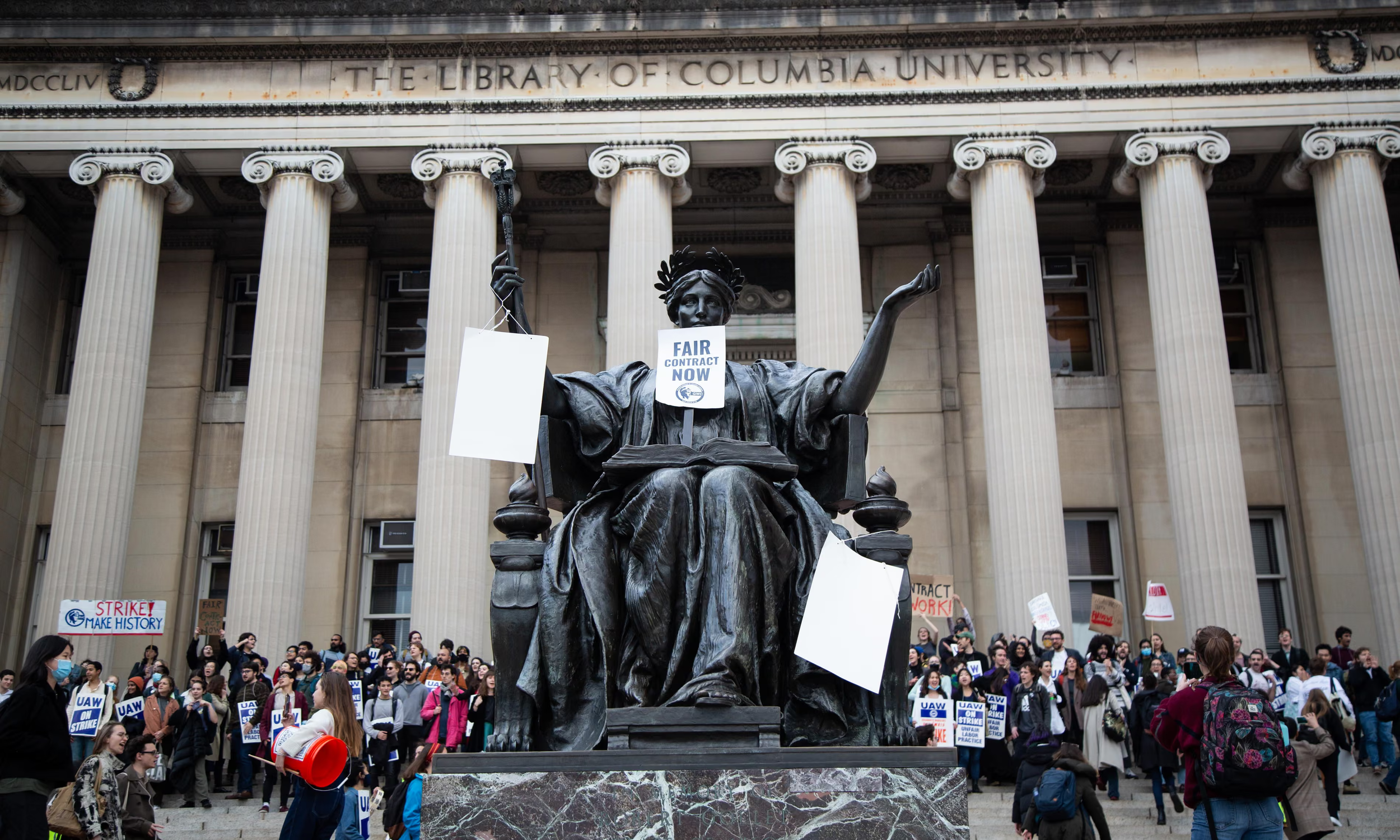
Despite the ruling in 2016, the Columbia University administration fought the unionization effort aggressively. The contract negotiation between the university and the Student Workers of Columbia (SWC-UAW) started in 2019, and no agreement was reached for more than two years. In late 2021, the SWC-UAW launched an open-ended strike. For 10 weeks, classrooms went dark, papers went ungraded, and the prestigious university's operations ground to a halt. During the strike, the university sent out illegal threats that the graduate workers would lose their appointments in the spring unless they went back to work. However, the students responded to the university with hard pickets at all entrances that shut down the campus during business hours.
The university was forced to provide a groundbreaking contract in January 2022 when the strike ended. While they won significant wage increases (bringing the floor for Ph.D. students to $45,000), the most critical victory was non-monetary. The union won the right to "neutral third-party arbitration" for cases of discrimination and harassment. Previously, if a student was harassed by a professor, the university’s own Title IX office would adjudicate the case—essentially, the employer investigating itself. The union forced the university to allow an independent arbitrator to hear these sensitive cases. The new contract also won dental and vision coverage for graduates (worth more than a thousand dollars), which universities rarely provided to graduates in the past.
The Columbia contract set a "gold standard" for private universities. It shattered the idea that academic prestige was a substitute for a living wage and basic worker protections. It triggered a domino effect, leading to successful union campaigns at Yale, MIT, and other elite institutions that had resisted organizing for generations.
Additional Reading: Columbiagradunion
The University of California (UC) Mega-Strike
Although the student workers from public universities were allowed to unionize and bargain from the last century, their salary was governed by the state labor law and the budget of the state, which provides a lower salary and is harder to bargain against compared to the contracts of student workers at private universities. The University of California (UC) mega-strike is a good example of how hard it is to make changes in the government system. The University of California system is the largest academic employer in the nation. However, its campuses are located in some of the most expensive real estate markets in the world: Berkeley, Los Angeles, Santa Cruz, and San Diego. By 2022, "rent burden" was the primary issue. Graduate workers were spending 50% to 60% of their income on rent, with some living in cars or couch-surfing while teaching undergraduates.
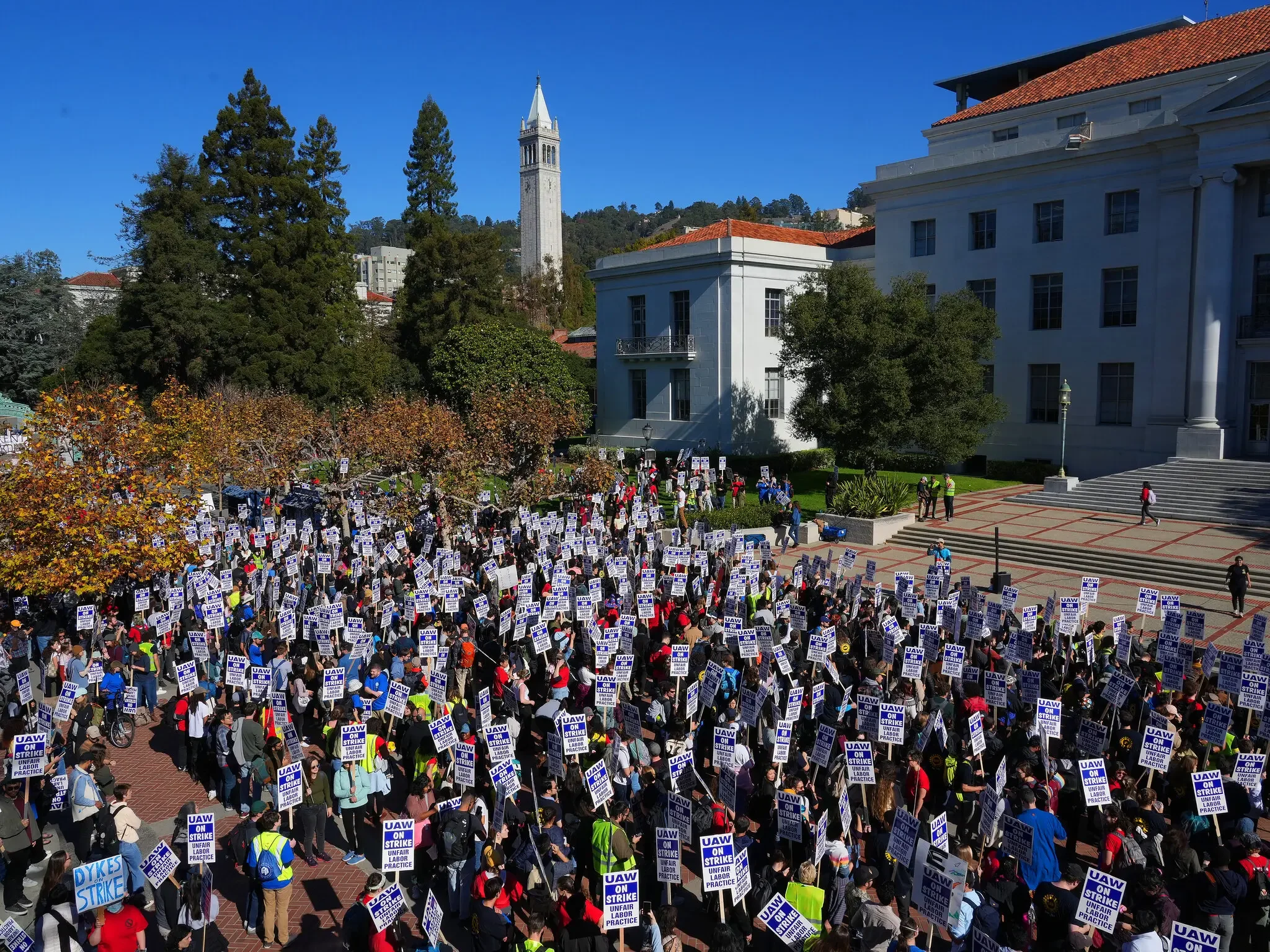
Despite the difficulties to bargain with the legislature of the state, the UC scholars had a strong weapon of unity. In the past, universities successfully divided different types of workers, giving a raise to researchers but ignoring the TAs. This time was different. Four separate bargaining units, including TAs, RAs, postdoctoral scholars, and academic researchers, joined forces to form a striking community of more than 48000 people. Despite the differences in their jobs, they negotiated as a single block. When the university tried to offer deals to small groups, the other groups refused to back down. Even tenured professors, who were not on strike, showed their support. Many professors cancelled their classes or refused to cross the picket lines. This solidarity made it impossible for the university to operate normally.
The strike reached a critical turning point in December. The university offered a strong deal to the postdoctoral scholars and academic researchers. These workers ratified their contracts early, while the 36,000 graduate workers were still fighting for a contract. However, the pressure on the university remained high. The strike dragged into finals week, leaving tens of thousands of exams ungraded and final grades withheld. The administration realized they could not start the spring semester in chaos.
The strike ended in late December with a historic victory. The contract raised the minimum base pay for some workers by nearly 50%, with even higher increases for those at the most expensive campuses like Berkeley and UCLA. They also won protections against bullying and significant increases in childcare subsidies. They shattered the idea that public universities cannot pay living wages and proved that even in a massive, bureaucratic state system, organized labor can force the government to find the money.
Additional Reading: LaborNotes
Graduate Labor Union at Brown University
The labor movement at Brown University began with the Graduate Labor Organization (GLO @gradlabororg). Unlike its peers at Columbia and Yale, the Brown administration did not strictly stonewall the graduates from unionization. Following the 2016 NLRB ruling, Brown agreed to let the graduates vote for the new union after the graduates’ petition. After a vote with the American Arbitration Association (AAA), the graduates won the vote, and Brown recognized GLO in 2018. This seemingly cooperative start, however, did not prevent conflict.
Since its establishment, GLO has secured several significant contract victories (all contracts can be viewed here). In 2020, the union won its first contract, which included a 2.5% stipend raise during a period when pay was frozen for non-union staff. This agreement also provided a one-year extension of funding for graduates affected by COVID-19, stronger protections against discrimination and harassment, a $600 healthcare reimbursement (on top of insurance coverage), and 75% subsidies for dependents’ health and dental insurance. In 2024, GLO ratified its second contract, which raised the yearly stipend to $52,198 (for FY26—an increase of more than 80% compared to FY16). It also granted full vision care, child healthcare, and dental coverage to all PhD and MFA students. Additionally, international graduates secured university-covered healthcare and dental premiums for their spouses, as well as reimbursement for immigration-related costs, including visa application fees.
A key factor in GLO’s success is its commitment to advocating for ALL students at Brown University, not just its own members or PhD students in specific fields. While the University has often attempted to limit the scope of the bargaining unit (the group of legally recognized workers), GLO has consistently pushed for broader inclusion. In the first contract of 2020, the union demanded equal stipends for graduates in both science and humanities departments, making Brown one of the first universities in the nation to adopt "stipend parity."
This commitment expanded in the 2024 contract, where GLO successfully pushed for an additional article raising the hourly wage of Master’s RAs and graders to $22.50. Previously, these Master’s students performed work similar to their PhD counterparts but received a meager minimum wage of $15 per hour. Furthermore, GLO prevented the university from increasing undergraduate tuition or cutting "top-up" funds to offset stipend raises. By taking the university to arbitration on this issue and winning, GLO secured a crucial victory: it established that a contract is binding law, not a suggestion. The ruling confirmed that the university could not simply shuffle money around or exploit undergraduate students to fund raises for PhD students.
Most recently, following the passage of a Rhode Island state bill guaranteeing that all student workers are classified as employees, GLO has begun collecting petition cards from students on fellowships. This effort aims to bring these students into the union, allowing them to join their peers in collective bargaining, providing them with the crucial third-party grievance procedure and other protections. All these actions reflect the ideal of the GLO that it is fighting for the common wealth of all the members in the community.
The GLO has joined to form the Local 6516 alongside the Teaching Assistant Labor Organization (TALO), the Labor Organization of Community Coordinator (LOCC), and the Brown University Postdoc Labor Organization (BPLO). It has supported the other unions’ movement, like the 2024 strike on the move-in day by LOCC, the contract negotiation by TALO and BPLO, and the encampment for Palestine led by undergraduate students. The history of the other three unions in our Local will be discussed below.
The Undergraduate Awakening (TALO) @talabororg
For decades, the Computer Science department at Brown University has operated as a pedagogical marvel. It is a massive engine of instruction, powered almost entirely by a unique fuel source: undergraduate labor. Unlike research universities that rely on armies of doctoral candidates, Brown’s celebrated program depends on hundreds of Undergraduate Teaching Assistants (UTAs). These students, often mere months ahead of the peers they mentor, serve as the department’s operational linchpin. They grade complex code, troubleshoot bugs during chaotic office hours, and offer emotional triage to stressed classmates. For years, the administration framed this labor not as employment, but as an honor—a prestigious credential that paid dividends in future career prospects rather than current wages.
By the autumn of 2022, the prestige of the job had started to fade. The reality of the work was often exhausting. UTAs described a chaotic "wild west" environment where expectations changed constantly depending on what the professor wanted. Students found themselves grading assignments late into the night, often hurting their own grades just to keep up with the work. The pay was low, and the boundaries were unclear. When problems came up—whether about pay or behavior—there was no official way to resolve them. Students were forced to make uncomfortable complaints to the very same professors who controlled their grades.
In response, these student workers initiated a campaign that would shatter the conventional wisdom of academic labor. They formed the Teaching Assistant Labor Organization (TALO). Their strategy was sophisticated and intimate. Leveraging the social networks inherent to undergraduate life, they organized peer-to-peer, turning study groups into strategy sessions. They argued that their "learning opportunity" was, in fact, essential labor that generated millions in tuition revenue. When the university declined to voluntarily recognize their union, the students forced an election. The result was a resounding rebuke of the status quo: the union won in a landslide, with 303 votes in favor (91.5%) and only 28 against.
The resulting contract, ratified in 2023, did more than just raise wages; it professionalized the undergraduate experience. The agreement codified a significant pay increase (29%), raising the hourly floor to $20 to $27.50, depending on the role, and a guaranteed increase over the following years with inflation. This move fundamentally redefined their stipend from "pocket money" to a living wage. Perhaps more importantly, the contract secured critical quality-of-life protections. It enshrined the right to work remotely, allowing TAs to grade from the safety of their dorms rather than being tethered to campus labs until the early hours of the morning.
Furthermore, the agreement established a formal grievance procedure with binding arbitration. This introduced a new layer of accountability, ensuring that disputes would be settled by a neutral third party rather than internal politics. Through this victory, TALO demonstrated that undergraduate labor is neither transient nor powerless. They proved that even a workforce that turns over every four years can build enduring institutions of power, setting a new precedent for student workers across the Ivy League.
Disruption on Move-In Day (LOCC) @locc.union
The momentum spread to Residential Life. The Labor Organization of Community Coordinators (LOCC), representing Resident Assistants (RAs), formed to demand that their compensation reflect the 24/7 nature of their jobs. Traditionally, RAs are paid in "room and board" credits, a system that ties their housing security to their employment. In most of the other Ivy League schools, RAs usually get all their residential and meal plan covered, with some even get part of their tuition fee covered. However, Brown does not even pay for a full “room and board” coverage.
In late 2024, negotiations for a first contract stalled. The university, claiming that it is facing a budget deficit of millions of dollars and looming federal funding cuts, attempted to hold the line on costs. In response, LOCC launched a strike on the single most critical day of the year: Freshman Move-In Day. The disruption was immediate and highly visible. Parents dropping off their children were met not by helpful guides, but by picket lines. The tactic worked. By January 2025, LOCC ratified a contract that significantly increased their stipends (to approximately $12,500) and, crucially, placed strict limits on "on-call" hours, protecting students from the burnout of being first-responders around the clock.
The Hidden Workforce (BPLO) @bplounion
For years, postdocs have been described as the "hidden workforce." At Brown University, they navigate a difficult gray area between student and faculty status. They had finished their PhDs and were running critical experiments yet only paid about 15% more than PhD students. They are facing a lot more pressure from the demands of their PI and from the competition from their peers, but with such a low salary, they cannot even earn a living for their family in their 30s.
That changed in 2023. Breaking the trend of bitter legal battles, postdocs organized a massive campaign that forced the university to choose cooperation over conflict. In January 2024, Brown voluntarily recognized the Brown Postdoc Labor Organization (BPLO) without forcing a messy election.
However, recognition was just the start. After sixteen months of tough negotiations, the union finally secured its first contract in October 2025. The victory was substantial. The agreement raised the minimum salary to $65,000, a significant jump from the previous floor of roughly $56,000.
Crucially, the contract addressed the specific needs of international scholars, who make up a large portion of the postdoc community. It secured guaranteed visa fee reimbursements and stronger protections against discrimination, turning what was once a temporary "training" role into a stable, professional job with real rights.